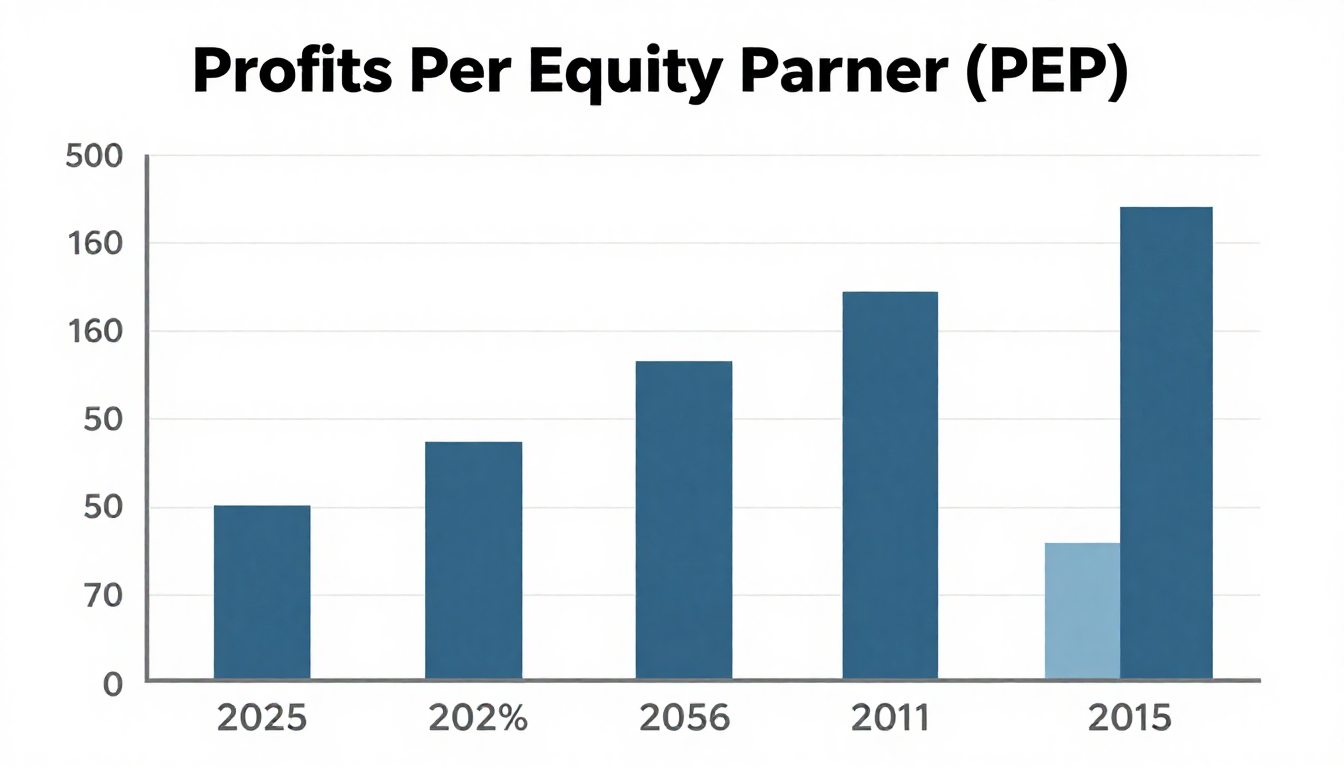
Understanding Profits Per Equity Partner (PEP)
In the competitive world of professional services—especially law, consulting, accounting, and investment firms—few financial metrics carry as much prestige and influence as profits per equity partner (PEP). This figure is often viewed as a benchmark of success, stability, and market power. It influences recruitment, lateral hiring, mergers, and even client perception.
While revenue figures can be impressive, PEP tells a deeper story. It reveals how effectively a firm converts revenue into distributable profit and how that profit is shared among its equity partners. For firms seeking to grow strategically and maintain long-term sustainability, understanding PEP is essential.
This article explores what profits per equity partner means, how it is calculated, why it matters, and the factors that influence it.
What Is Profits Per Equity Partner?
Profits per equity partner (PEP) is a financial metric used primarily in law firms and other partnership-based organizations to measure the average profit allocated to each equity partner.
Equity partners are owners of the firm. Unlike salaried or non-equity partners, equity partners share directly in the firm’s profits. PEP represents the portion of net profit each equity partner receives after operating expenses, salaries, and other costs are deducted.
In simple terms:
PEP = Total Net Profit ÷ Number of Equity Partners
This figure does not necessarily represent what every partner earns individually, but rather the average profit per equity partner.
Why Profits Per Equity Partner Matters
PEP plays a significant role in shaping a firm’s reputation and competitive position. Here are several reasons why it is so important:
PEP Signals Financial Strength
A high PEP suggests strong profitability, operational efficiency, and high-value client work. It demonstrates that the firm generates substantial returns for its owners.
PEP Attracts Talent
Top-performing lawyers, consultants, and advisors often consider PEP when evaluating lateral moves. A firm with high PEP can attract elite professionals who want a greater return on their contributions.
PEP Influences Rankings
Publications such as The American Lawyer publish annual rankings based on financial metrics like PEP. These rankings are closely watched within the legal industry and influence perception and prestige.
PEP Reflects Strategic Focus
A rising PEP often reflects strong pricing strategies, disciplined expense management, and a focus on high-margin practice areas.
How Profits Per Equity Partner Is Calculated
Calculating PEP involves a straightforward formula, but the components require clarity and consistency.
Step 1: Determine Net Profit
Net profit is calculated by subtracting all operating expenses—including salaries, office costs, administrative expenses, and other overhead—from total revenue.
Step 2: Identify Equity Partners
Not all partners are equity partners. Many firms operate a two-tier partnership model that includes both equity and non-equity partners. Only equity partners are included in the PEP calculation.
Step 3: Divide Net Profit by Equity Partners
The final step is dividing total net profit by the number of equity partners.
For example, if a law firm earns $200 million in net profit and has 100 equity partners, its PEP would be $2 million.
Factors That Influence Profits Per Equity Partner
Several internal and external factors can significantly impact PEP.
Revenue per Lawyer
Higher revenue per lawyer often correlates with higher profitability. Firms that focus on premium billing rates and high-value matters tend to see stronger PEP figures.
Cost Structure
Efficient operations, controlled overhead, and streamlined administrative functions improve net profit margins, which directly increases PEP.
Leverage Model
Leverage refers to the ratio of associates to partners. Firms with effective leverage models—where associates generate substantial billable work under partner supervision—can enhance profitability.
Equity Partner Count
Reducing the number of equity partners while maintaining profit levels can raise PEP. Some firms strategically adjust equity partner numbers to optimize this metric.
Practice Area Mix
Certain practice areas, such as corporate mergers and acquisitions or complex litigation, tend to generate higher margins compared to lower-rate service areas.
Economic Conditions
Market conditions, client demand, and global economic stability all affect profitability and, consequently, PEP.
The Difference Between PEP and Revenue Per Lawyer
Although both are key performance indicators, PEP and revenue per lawyer measure different aspects of financial performance.
Revenue per lawyer measures productivity and billing strength across the firm. It reflects how much revenue each lawyer generates on average.
PEP measures how much profit equity partners take home after expenses. It reflects ownership returns rather than overall productivity.
A firm can have high revenue per lawyer but lower PEP if expenses are high. Conversely, a firm with strong cost discipline may achieve strong PEP even with moderate revenue figures.
Criticisms of Profits Per Equity Partner
Despite its widespread use, PEP is not without controversy.
It Can Be Manipulated
Firms can increase PEP by reducing the number of equity partners without actually increasing overall profitability.
It Masks Compensation Variability
PEP is an average figure. In reality, compensation among equity partners often varies widely based on performance, seniority, or contribution.
It Encourages Short-Term Decisions
Overemphasis on PEP may incentivize firms to prioritize immediate profit over long-term investment, such as technology upgrades or associate development.
It Does Not Reflect Culture
High PEP does not necessarily mean a healthy work environment, strong mentorship, or long-term sustainability.
How Law Firm Rankings Use PEP
Industry rankings frequently rely on PEP as a primary metric. For example, The American Lawyer publishes the Am Law 100 and Am Law 200 lists, which rank U.S. law firms by revenue, PEP, and other financial data.
These rankings influence lateral hiring, merger discussions, and even client confidence. Firms with consistently rising PEP figures often gain reputational advantages.
However, sophisticated observers understand that PEP is only one piece of the financial picture.
Strategies Firms Use to Improve PEP
Firms seeking to improve profits per equity partner often focus on strategic initiatives.
Enhancing Pricing Power
Raising billing rates in line with market demand can increase revenue without increasing headcount.
Improving Efficiency
Adopting legal technology and project management tools reduces operational waste and increases margins.
Selective Growth
Instead of expanding broadly, firms may target high-margin practice areas or geographic markets.
Optimizing Partnership Structure
Careful management of equity partnership admissions ensures that profit pools remain strong and sustainable.
Controlling Overhead
Office space optimization, outsourcing certain administrative tasks, and investing in automation can improve profitability.
PEP in Other Professional Services
While commonly associated with law firms, profits per equity partner is also used in accounting, consulting, and investment partnerships.
Large accounting networks like Deloitte and PwC track partner profitability, though their reporting structures may differ.
Similarly, consulting firms such as McKinsey & Company distribute profits among partners based on equity ownership and performance.
In each case, PEP serves as a measure of how effectively the organization converts revenue into partner-level returns.
Long-Term Sustainability and PEP
A sustainable PEP trend matters more than a single strong year. Firms that experience sharp PEP spikes due to temporary market conditions may struggle if underlying structural issues remain unresolved.
Healthy long-term growth requires:
Investment in talent development
Technology modernization
Client diversification
Strategic risk management
Balancing profitability with reinvestment ensures stability during economic downturns.
The Future of Profits Per Equity Partner
As the professional services landscape evolves, the importance of PEP may shift. Increasing competition, alternative legal service providers, and artificial intelligence are reshaping cost structures and billing models.
Clients are demanding greater transparency and value. Firms that rely solely on premium billing rates may face pressure. In response, sustainable profitability will depend more on efficiency and innovation than pure pricing power.
Nevertheless, PEP will likely remain a central performance indicator for partnership-based firms.
Conclusion
Profits per equity partner is one of the most influential financial metrics in partnership-based organizations. It reflects how effectively a firm converts revenue into distributable profit and provides insight into operational efficiency, strategic focus, and competitive strength.
While PEP offers valuable information, it should not be viewed in isolation. Revenue growth, cost discipline, partner structure, and long-term investment strategies all play critical roles in shaping a firm’s financial health.
For law firms, consulting firms, and accounting partnerships, maintaining a strong and sustainable PEP requires balancing short-term profitability with long-term strategic planning. When managed responsibly, PEP becomes more than a number—it becomes a reflection of organizational excellence.
(FAQs)
What does profits per equity partner mean?
Profits per equity partner (PEP) is the average amount of net profit allocated to each equity partner in a firm after expenses are deducted.
How is profits per equity partner calculated?
PEP is calculated by dividing total net profit by the number of equity partners in the firm.
Why is PEP important in law firms?
PEP is important because it signals financial performance, attracts top talent, influences industry rankings, and reflects strategic success.
Can profits per equity partner be misleading?
Yes. PEP can be influenced by reducing the number of equity partners or deferring expenses, which may not reflect true operational strength.
Is PEP used outside of law firms?
Yes. Accounting, consulting, and other partnership-based professional service firms also use similar profitability metrics to measure partner returns.